
The Short Answer
If you were working two jobs when you were hurt, Illinois workers’ compensation can count the wages from both jobs, not just the job where the injury happened. Under Section 10 of the Illinois Workers’ Compensation Act, this applies when you were working concurrently for two or more employers and the employer where you were hurt knew about the other job before your injury. Because your weekly benefits are based on your wages, including the second paycheck can make a large difference.
Why Your Average Weekly Wage Matters
Most workers’ compensation benefits are calculated from your average weekly wage, often called the AWW. While you are off work, temporary total disability benefits (TTD) are generally two thirds of your average weekly wage under Section 8(b) of the Act, within state minimums and maximums. Permanent partial disability benefits for a loss of use of a body part or of the person as a whole are paid at 60 percent of your average weekly wage. Wage differential benefits under Section 8(d)(1) use a different formula, based on the difference between what you earned before the injury and what you can earn after it.
If the insurance company calculates your wage using only one of your two jobs, every check you receive may be lower than it should be. For more on how the number is figured, see our article on how your average weekly wage is calculated.
The Rule in Section 10
Section 10 says that when an employee “is working concurrently with two or more employers and the respondent employer has knowledge of such employment prior to the injury,” the wages from all of those employers are counted as if they were earned from the employer responsible for paying benefits.
That sentence contains two requirements. First, you must have been working concurrently, meaning you held both jobs during the same period. Second, the employer where you were hurt must have known about the other job before the injury. The employer where you were injured pays the benefits. Your other employer does not.
What Counts as Knowledge
You must prove both requirements, and knowledge is often where these claims are disputed. In Bagwell v. Illinois Workers’ Compensation Comm’n, 2017 IL App (4th) 160407WC, a worker who also served as a pastor could not include that income because the evidence did not show his employer knew the church work was paid employment. Section 10 covers paid work, not volunteer activity.
The 2026 decision discussed below shows the other side. When the employer knew from the start that the worker held another paid job, that knowledge was enough.
What If the Other Job Was on Layoff or Furlough?
A second job does not stop counting just because you were temporarily off from it when you were hurt. In Flynn v. Industrial Comm’n, 211 Ill. 2d 546 (2004), the Illinois Supreme Court held that a worker on a seasonal layoff from one job was still concurrently employed, because that job had not ended and he expected to return.
The J-H Alliance Decision
In J-H Alliance Inc. v. Illinois Workers’ Compensation Comm’n, 2026 IL App (1st) 251899WC, a published opinion, the Illinois Appellate Court, Workers’ Compensation Commission Division, applied these rules to a worker hurt at a UPS Store in October 2020.
She had two jobs. Since April 2019 she had worked at O’Hare Airport for a company that staffed airline gates. A month or two later, she started part time at the UPS Store, and the owner knew when hiring her that she worked at the airport. In March 2020, the airport employer furloughed her because of COVID-19. She was still on furlough when she injured her wrist at the store, and she was recalled to the airport job in July 2021.
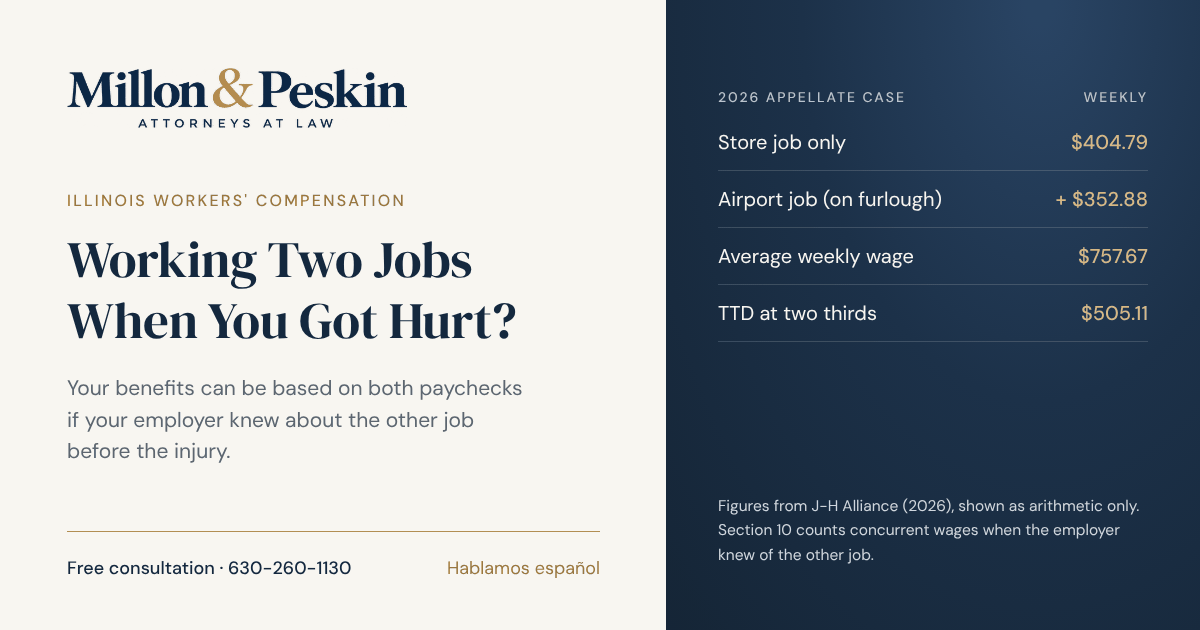
The Commission first set her average weekly wage at $404.79, based only on the store job. On review, the circuit court sent the case back. The Commission then included the airport wages and set her average weekly wage at $757.67, and the appellate court affirmed.
The court reasoned that the employer knew about the airport job before the injury, and that a furlough is temporary by nature. In the court’s words, “to be temporary simply means impermanent, not necessarily a brief, short period of time.” Her airport job would have been part of her future earnings if she had not been hurt.
In practical terms, the court treated the furlough as a pause, not an ending. She was waiting to be called back to the airport, and the injury kept her from returning. A worker whose other job has permanently ended is in a different position, because that job is no longer part of the earnings the injury interrupted.
The difference was substantial. The record reflects a stipulated airport wage of $352.88 per week, and $404.79 plus $352.88 equals the $757.67 the Commission used. Two thirds of $757.67 is $505.11, which was the weekly temporary total disability rate on remand.
How Much Difference the Second Job Made
If only the store wages had been used, two thirds of $404.79 would be about $269.86 a week in TTD. Counting both jobs produced a TTD rate of $505.11 a week, a difference of about $235.25 every week. For a worker who is off work for several months, that difference adds up quickly.
These figures are arithmetic from the numbers in the opinion, shown to illustrate how the rule works. Actual benefits depend on the facts of each case, the evidence of wages and knowledge, and the state minimum and maximum rates.
Proving the Second Job
Section 10 applies to paid employment, so the wages from the second job must be proven, not just described. Pay stubs, W-2 forms, bank deposits, tax returns, and testimony from a supervisor at the second job can all help. If the second job paid in cash or kept poor records, the claim can still be made, but the evidence has to be assembled carefully, and the insurance company is more likely to dispute it.
Knowledge must be proven too. A job application that lists the other employer, a work schedule built around the other job, or a manager who knew about it can show that the employer where you were hurt knew about the second job before the injury.
Be accurate with your attorney about how you were paid, and do not create or change records after an injury. An attorney can review what evidence already exists for the job, the wages, and the employer’s knowledge.
What to Do If You Have Two Jobs
If you work two jobs now, make sure each employer knows about the other, and keep a record of it, such as a job application or an email that mentions your other position. Knowledge must exist before an injury, so this cannot be fixed afterward.
If you have already been hurt, gather pay stubs, W-2 forms, and schedules from both jobs, and tell your attorney about every job you held. Check how the insurance company calculated your average weekly wage. If it used only one paycheck, ask why. An incorrect wage figure affects every benefit check and any settlement.
Frequently Asked Questions
Does my second employer have to pay my benefits? No. The employer where you were injured, through its insurance company, pays the benefits. The second job’s wages are added to the calculation.
What if my employer did not know about my other job? Then the second job’s wages generally cannot be included under Section 10. Whether the employer knew is a question of evidence, so it is worth reviewing carefully.
Does a part-time second job count? Yes. Part-time paid work can count if both requirements are met.
Does collecting unemployment during a furlough end the second job? Not necessarily. In J-H Alliance, the worker received unemployment benefits while furloughed, and her airport wages were still counted. The unemployment benefits themselves are not wages and are not added to the calculation.
What if I had three jobs? Section 10 refers to two or more employers, so wages from each concurrent job can count if the requirements are met for each one.
Talk to an Illinois Workers’ Compensation Attorney
If you held more than one job when you were hurt, the way your wage is calculated can change the amount of every check. The attorneys at The Law Offices of Millon & Peskin, Ltd. can review your wage records and explain your rights. We represent injured workers throughout the Chicagoland area, including DuPage, Cook, Will, Kane, and Lake counties, from our offices in Wheaton and Rosemont. Learn more about our Illinois workers’ compensation practice and how average weekly wage is calculated, or call 630-260-1130 for a free consultation. Hablamos español.