
If the insurance company denied or delayed your workers’ compensation claim, you may have used your own health insurance to get treatment. Some workers use the coverage they have so that treatment is not put on hold while the dispute is worked out. That can leave you with real questions: Who is supposed to pay these bills? Will my health plan want its money back? Why does the award not match the total on my hospital bills?
Under the Illinois Workers’ Compensation Act, your employer is responsible for the reasonable and necessary medical care for a work injury. How that responsibility works when a group health plan has already paid part of the bills is less obvious. Here is what injured workers in Illinois should know.
Using Your Health Insurance While Your Workers’ Comp Claim Is Disputed
Section 8(a) of the Act (820 ILCS 305/8(a)) requires your employer to pay for the medical care reasonably required to cure or relieve the effects of a work injury. When the employer does not dispute a particular treatment, Section 8.2(e) (820 ILCS 305/8.2(e)) says the provider may not hold you liable for it. Keep in mind that an employer can accept the injury and still dispute a specific treatment or charge, so an accepted claim does not always mean you will never see a bill.
When the employer does dispute a bill, the law gives the provider a way to seek payment from you. Under Section 8.2(e-5), if the employer denies that the injury is covered, the provider may bill you for its actual charges. Under Section 8.2(e-10), if the employer pays only part of a bill, the provider may bill you for the rest, but no more than the lowest of the actual charge, any negotiated rate, or the fee schedule amount. Two protections limit those rights.
Group health insurance. If you give the provider your group health plan information, Section 8.2(e) says those collection rules do not apply. The provider may bill your plan instead, and if the plan covers the treatment, the provider can charge you only your applicable deductible, copay, or coinsurance. The law allows the provider to submit the claim to your plan. It does not guarantee the plan will cover it. Tell the provider and the plan that the injury happened at work, and keep the plan’s Explanation of Benefits and receipts for anything you pay.
A filed claim. If you do not have group health coverage, or have not given the provider that information, the second protection matters. Once an Application for Adjustment of Claim is on file with the Illinois Workers’ Compensation Commission, tell the provider’s billing office that the claim is on file, give them the case number, and keep a copy of what you send. The provider must then stop collecting the disputed charges. Filing alone is not enough. The provider has to be told.
While the case is pending, the provider can still mail you reminders. The reminders must say they are not bills, and they may not be reported to credit agencies. If a reminder asks for information about your case, such as the case number or its status, provide it within 90 days of the date on the reminder. If you do not, the provider can resume collection.
A collection pause does not erase the bill. Under Section 8.2(e-20), providers may resume collection after a final award, judgment, or settlement, although for compensable care they may not charge more than the actual charge or the fee schedule amount. Before you settle, find out which bills are still open, who will pay them, and whether any health plan is asking to be repaid. Our post on how workers’ compensation settlements work in Illinois explains more about what happens at that stage.
If the insurance company is refusing to approve the care your doctor recommends, that is a separate problem with its own steps. See what to do when the insurance company denies your doctor’s recommended treatment.
Billed, Paid, and Written Off: Why the Award Is Not the Total on Your Bills
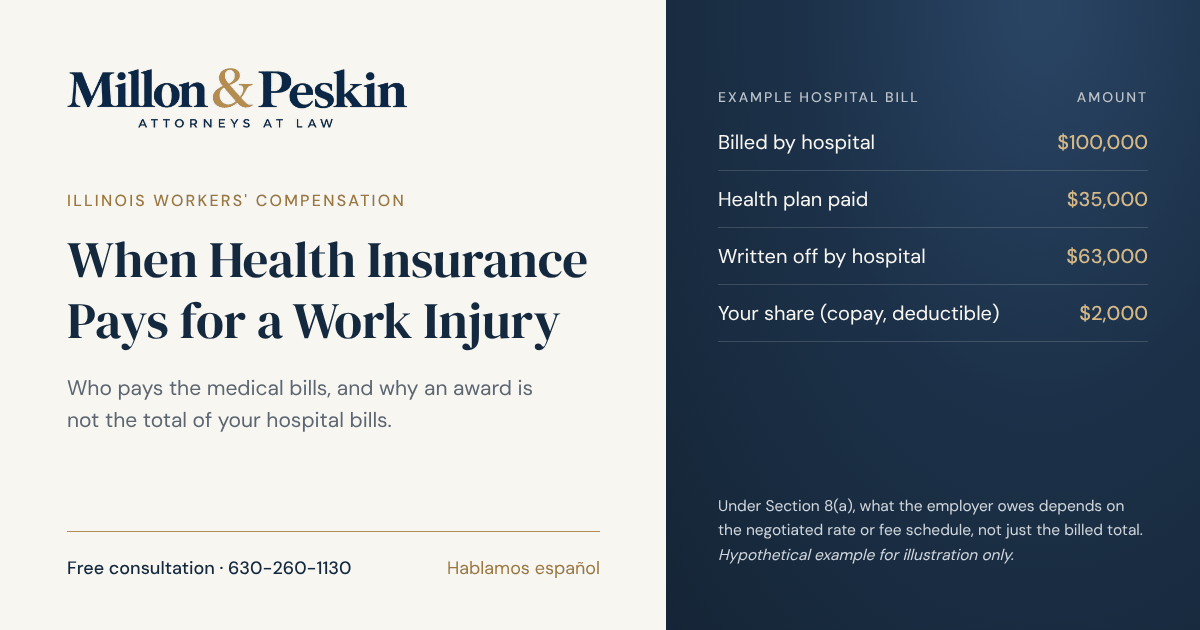
A hospital bill can show several numbers, and they mean different things. Picture a hypothetical bill for $100,000. Your health insurer pays $35,000 under its contract with the hospital. The hospital writes off $63,000 because of that contract. The Explanation of Benefits shows the remaining $2,000 as your share under the plan, meaning your deductible, copay, or coinsurance.
Many injured workers assume that if the arbitrator awards the medical bills, the employer must pay the $100,000 face amount. Illinois law does not work that way. Section 8(a) says the employer pays the negotiated rate, if one applies, or otherwise the lesser of the provider’s actual charges or the Commission’s medical fee schedule under Section 8.2.
In Perez v. Illinois Workers’ Compensation Commission, 2018 IL App (2d) 170086WC, the Appellate Court, Workers’ Compensation Commission Division, held that the negotiated rate does not have to be one the employer arranged. A rate negotiated by the worker’s group health insurer can count. The court reasoned that paying more than the providers actually accepted would create a windfall.
In practice, the applicable rate determines what is owed for covered care. The bills, payment records, and any valid reimbursement claims then help determine who should receive that money. In the example above, if you already paid the $2,000, save proof that you paid it. If it is still unpaid, confirm the balance with the provider. The same $2,000 should not show up both as an open bill and as an expense you already paid. You can read more about payment of medical bills in Illinois workers’ compensation cases.
Your Copays and Out-of-Pocket Costs, and Paying Back the Health Plan
The money you paid yourself matters. Deductibles, copays, coinsurance, and prescriptions you paid for a work injury are part of the medical expenses your employer may be ordered to cover. They are also the easiest numbers to lose track of, so keep every receipt and statement.
What happens to the health plan’s payments depends partly on whose plan it was. When the plan is a group plan your employer paid into, in whole or in part, Section 8(j) of the Act (820 ILCS 305/8(j)) gives the employer a credit for benefits that plan paid but should not have paid because the injury was work related. In exchange, the employer must hold you harmless from claims made against you because of those payments, to the extent of the credit. The credit does not cover payments the plan would have made whether or not the injury was work related.
If the treatment was paid by a plan your employer did not fund, such as a spouse’s health insurance or a plan from a later job, that plan may ask to be repaid from your recovery. Whether it can collect depends on the plan’s terms and the law that applies to it. Medicare and Medicaid have their own repayment rules for payments they already made. Repaying Medicare for past care is a separate issue from setting aside money for future care in a Medicare set-aside. Reviewing these reimbursement claims is part of what a lawyer does before a case is closed.
Why Your Medical Records and Payment History Matter
A 2026 decision from the Appellate Court shows how much the paperwork matters. In Jenkins v. McLaughlin Body Co., 2026 IL App (4th) 250962, the worker went to circuit court under Section 19(g) of the Act to enforce a Commission award for medical expenses. The circuit court entered judgment based on the original billed amount of $165,353.54. The Appellate Court held that this improperly enlarged the Commission’s award, because most of the bills had been paid through group health insurance at lower amounts. It directed entry of judgment for $54,546.05, which included interest.
The lesson for injured workers is practical. The medical part of your case is proven with documents, not just bills. Before a hearing or settlement, your lawyer needs to know what each provider charged, who paid what, what was written off, and what is still owed. Gathering this early can prevent a second fight about the amount after you have already won the medical issue.
You can help by keeping:
- Every Explanation of Benefits (EOB) from your health insurer
- Itemized statements from each provider showing payments, adjustments, and the current balance
- Receipts for copays, deductibles, and prescriptions
- Any bill, collection letter, or reminder notice from a provider
- Letters from your health plan asking about an accident or repayment
If a provider or collection agency contacts you about a work injury bill while your case is pending, do not ignore it. Tell your lawyer, and make sure the provider knows your claim is on file with the Commission. For a short answer to this question, see our page on what happens when group health insurance paid your work injury bills.
Talk to a Lawyer About Your Medical Bills
Using your health insurance after a work injury does not give up your workers’ compensation rights. It does mean there are more numbers to track and more parties who may want to be repaid. Sorting that out correctly protects you from surprise bills and helps make sure the medical part of your case reflects what was actually paid.
If you have been hurt at work and have questions about who should pay your medical bills, the workers’ compensation attorneys at The Law Offices of Millon & Peskin, Ltd. can help. We represent injured workers throughout the Chicagoland area, including DuPage, Cook, Will, Kane, and Lake counties, from our offices in Wheaton and Rosemont. Consultations are free, and you pay no fee unless there is a recovery. Call us at 630-260-1130. Hablamos español.