
Last reviewed: November 2, 2026
An Illinois workers’ compensation settlement chart can help explain how a permanent injury is valued. But the chart does not assign a fixed dollar amount to a hand, knee or back injury.
Instead, Illinois law assigns weeks of compensation to certain body parts. For a scheduled permanent partial disability (PPD) award, those weeks are multiplied by the percentage of permanent loss of use and the worker’s applicable weekly PPD rate.
Below is the Illinois body-part schedule, an example of the calculation, and the important exceptions to check before relying on the numbers.
Illinois Workers’ Compensation Body-Part Schedule
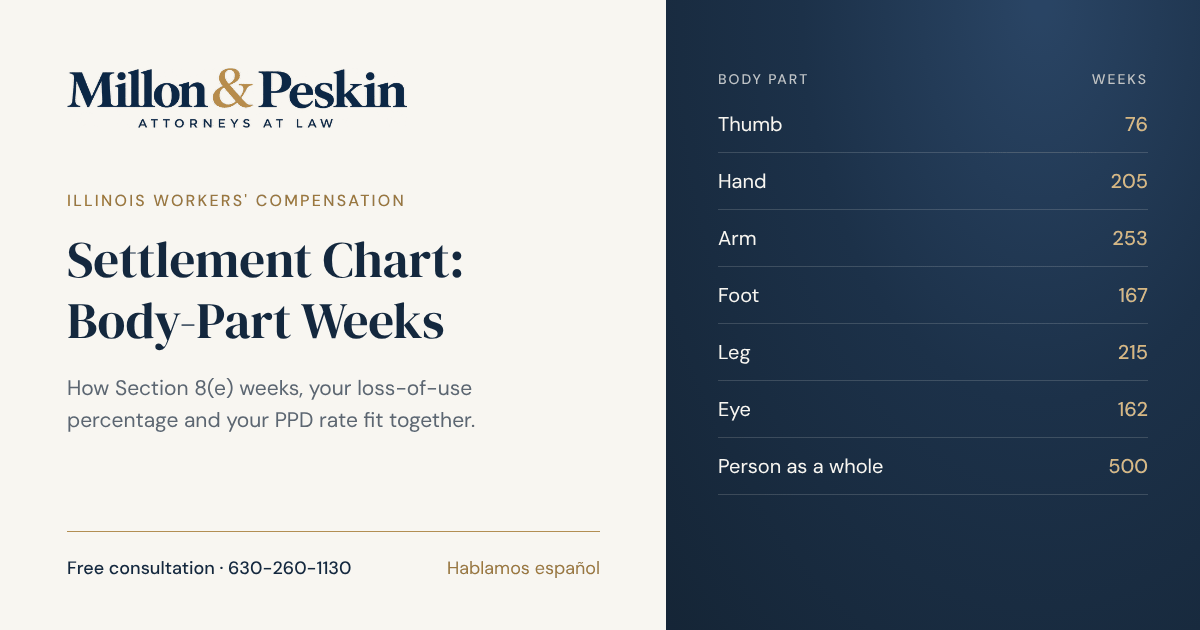
Section 8(e) of the Illinois Workers’ Compensation Act provides the following weeks for complete loss or permanent and complete loss of use. These general figures apply to injuries on or after February 1, 2006, subject to the exceptions explained below.
| Body part | Weeks for complete loss or loss of use |
|---|---|
| Thumb | 76 |
| Index finger | 43 |
| Middle finger | 38 |
| Ring finger | 27 |
| Little finger | 22 |
| Great toe | 38 |
| Each other toe | 13 |
| Hand | 205* |
| Arm | 253 |
| Foot | 167 |
| Leg | 215 |
| Eye | 162 |
| Hearing in one ear | 54 |
| Hearing in both ears | 215 |
| One testicle | 54 |
| Both testicles | 162 |
*Repetitive-trauma carpal tunnel claims use a separate 190-week hand figure and percentage limits, discussed below.
Certain amputations and surgical removal of an eye carry additional weeks:
| Injury | Total scheduled weeks |
|---|---|
| Arm amputation above the elbow | 270 |
| Arm amputation at the shoulder joint, or so close to it that an artificial arm cannot be used | 323 |
| Leg amputation above the knee | 242 |
| Leg amputation at the hip joint, or so close to it that an artificial leg cannot be used | 296 |
| Surgical removal of an eye (enucleation) | 173 |
Hearing-loss claims also have special statutory requirements, including how hearing is measured. For an older injury, check the schedule that applies to its date rather than assuming today’s figures apply. See Section 8(e) and the Illinois Workers’ Compensation Commission’s handbook.
Most claims involve partial loss of use rather than complete loss. A worker may keep a hand, for example, but have lasting weakness, stiffness or reduced grip. The percentage assigned to that permanent loss determines how much of the scheduled number of weeks applies.
How Scheduled Weeks Become Dollars
For a scheduled PPD award, the basic calculation is:
Body-part weeks × percentage of permanent loss of use × weekly PPD rate
The starting PPD rate is generally 60% of the worker’s average weekly wage, subject to statutory minimums and maximums. Learn how your average weekly wage is calculated. Amputation and eye-enucleation claims have different maximum-rate rules from ordinary PPD claims, so the correct benefit category matters. See Section 8(b) and the Commission’s benefit rates.
Consider a hypothetical worker with an average weekly wage of $1,000, a weekly PPD rate of $600, and a 20% permanent loss of use of the hand from an injury governed by the ordinary 205-week schedule. Twenty percent of 205 weeks is 41 weeks, and 41 weeks at $600 is $24,600.
This is an illustration of the arithmetic, not a prediction or an average settlement. It assumes the wage, rate, body-part classification and percentage are correct, with no credits or other adjustments. It also does not account for attorney fees, expenses or the value of any medical rights addressed in a settlement.
Why the Percentage Matters
The chart supplies the number of weeks. It does not tell you the percentage of permanent loss your evidence supports.
For injuries on or after September 1, 2011, Section 8.1b directs the Commission to consider five factors:
- The physician-reported level of impairment under the American Medical Association’s impairment guides, when such a report is submitted;
- The worker’s occupation;
- The worker’s age at the time of injury;
- Future earning capacity; and
- Evidence of disability corroborated by treating medical records.
No single factor controls the result. A medical impairment rating is therefore not automatically the percentage used to calculate a PPD award. See Section 8.1b.
An impairment report is also not required in every case. In Corn Belt Energy Corp. v. Illinois Workers’ Compensation Commission, 2016 IL App (3d) 150311WC, the Appellate Court, Workers’ Compensation Commission Division, held that Section 8.1b does not require either party to submit one. When a report is provided, the Commission must consider it with the other statutory factors. Read the opinion.
Two workers who undergo the same operation may have different lasting limitations and different demands at work. Medical records documenting strength, motion, symptoms and restrictions help explain those differences. Read more about PPD ratings in Illinois.
Back, Neck and Shoulder Injuries: The 500-Week Framework
Some permanent injuries are evaluated under Section 8(d)(2) as a loss of the person as a whole, rather than under the body-part schedule. This commonly includes back, neck and shoulder injuries.
Under that provision, the percentage of disability is applied to 500 weeks. That does not mean every qualifying injury receives 500 weeks of compensation. A percentage award uses the corresponding fraction of those weeks.
Shoulder injuries deserve particular attention. In Will County Forest Preserve District v. Illinois Workers’ Compensation Commission, 2012 IL App (3d) 110077WC, the court held that the shoulder is distinct from the arm for purposes of the statutory schedule. Because the evidence established a shoulder injury, the court upheld benefits under the person-as-a-whole provision rather than the arm schedule. Read the opinion.
The medical evidence identifying the injured structure matters. The same percentage applied to 253 arm weeks and to 500 person-as-a-whole weeks produces very different results.
Hip injuries are treated differently from shoulder injuries. In Illinois, the hip is considered part of the leg, so a hip injury is generally valued under the leg schedule of 215 weeks rather than as a loss of the person as a whole.
The Special Rule for Repetitive-Trauma Carpal Tunnel
Carpal tunnel syndrome caused by repetitive or cumulative trauma has its own rule for injuries on or after June 28, 2011. The calculation uses 190 weeks for the hand, and the award ordinarily cannot exceed 15% loss of use of the hand. For cause shown by clear and convincing evidence, an award may exceed 15%, but it cannot exceed 30%. For example, 15% of 190 weeks is 28.5 weeks, and the weekly PPD rate is then applied to those weeks.
This rule applies specifically to repetitive or cumulative trauma carpal tunnel claims. It should not be applied automatically to every hand injury or every wrist condition. Read more about cumulative trauma injuries.
When a Percentage Award May Not Be the Right Approach
A scheduled or person-as-a-whole award does not cover every permanent disability situation. A worker whose injury prevents a return to the usual occupation and reduces earning capacity may qualify for wage differential benefits under Section 8(d)(1). Learn about wage differential benefits in Illinois. Permanent total disability benefits may apply in other circumstances, including certain combinations of complete losses specifically identified in the Act. These benefits require a different analysis from multiplying a body-part percentage by scheduled weeks.
What to Check Before Accepting a Settlement
The chart helps you check the framework of an offer. Before accepting, make sure you understand:
- which body part or benefit provision the offer uses;
- whether the correct injury-date schedule and weekly rate apply;
- what evidence supports the proposed percentage;
- whether wage differential or permanent total disability benefits should be considered;
- whether future medical benefits remain available; and
- what you will receive after applicable fees, expenses and credits.
A negotiated settlement can address issues beyond the PPD calculation, including disputed responsibility for the injury and future treatment. The agreement’s terms determine which rights are resolved.
If you have received a settlement offer or have questions about a permanent injury, the attorneys at The Law Offices of Millon & Peskin, Ltd. can review it with you. We represent injured workers throughout the Chicagoland area, including DuPage, Cook, Will, Kane and Lake counties, from our offices in Wheaton and Rosemont, and we serve clients in English and Spanish. Consultations are free, and we charge a fee only if you recover compensation. Call 630-260-1130 or learn more about our workers’ compensation practice.
This article provides general information about Illinois workers’ compensation law. The examples do not predict the outcome of any claim.